
Nectarous and Burn
I’m @ The Cloisters as usual. It’s almost literally in my backyard, so there’s never not a reason to go to the Cloisters. Whatever I’m feeling or thinking, there’s always something to hang onto at the Cloisters.
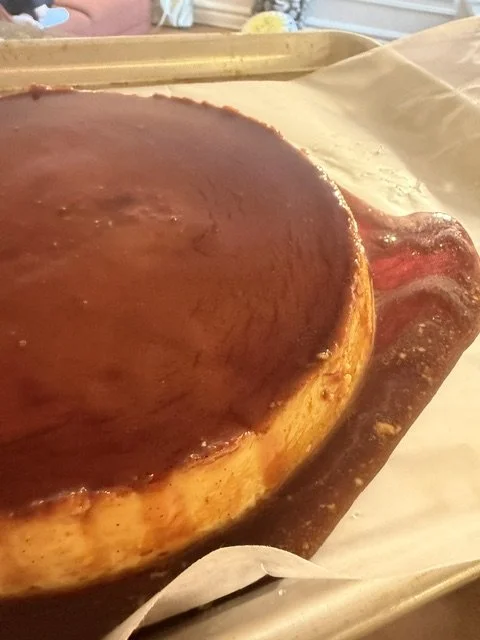
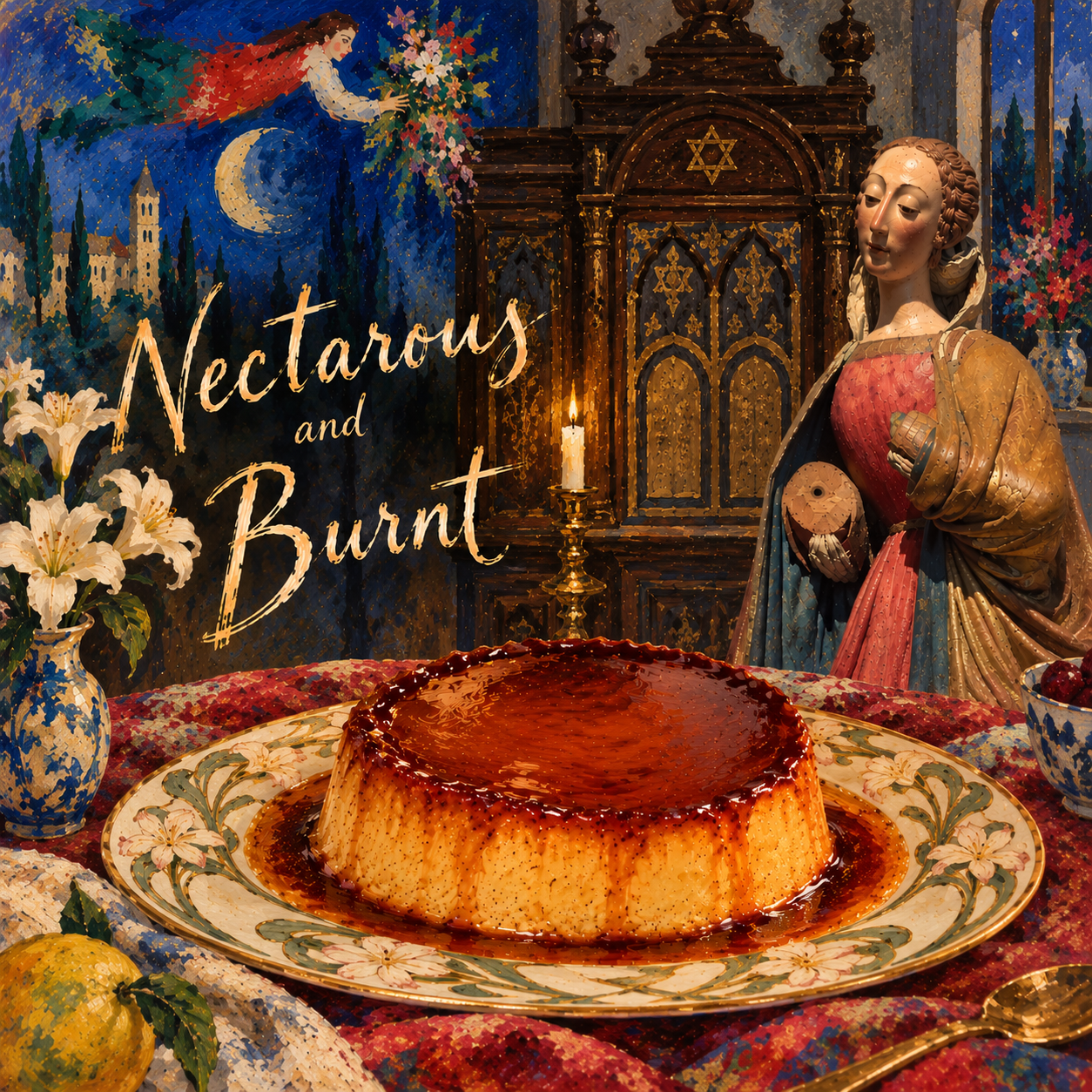
The flan/crème caramel was exquisite, and I don’t regularly fuck with that adjective, but really, it was otherworldly. The caramel splayed out on the top and ran down the sides, settling at the right spot between nectarous and burnt. And the color was as golden as the crown that Jesus wears in the Altarpiece with Scenes of the Passion that is right in front of me.
To be fair, creative expression certainly had its moments last night. Specifically from a ballerina, Victoriana, Callum’s latest Lavender Marriage candidate. “Just a sliver.” Poor Vicki, she consumed 4 slivers like a lean and hungry cat.
She then used my 15-foot hallway as a runway for a series of rather spectacular grand jetés. I always say of that hallway that empty space is the greatest luxury in a New York City apartment, and last night’s performance proved me right.
Monica brought a couple of people from her writer’s group, no one even remotely cool. Ugggh, writers. One of them wrote a flan haiku between shoveling spoonfuls of it into his mouth:
Crème caramel or
Flan, what difference does it
Make? It’s all yum-mee!
Instead of using my wedding china, I served the heavenly dessert on Grandmère Myriam’s Art Deco Limoges guest plates. The way the flan/crème caramel glimmered on those dishes was a plea for its own still-life scene. One that unfortunately did not occur.
I stop in front of a heavy, intricately carved credenza. And instantly, I am aware of energy in the vicinity that is concentrated on the back of my ponytail bun.
The person is actually not looking at me; he’s staring past my shoulder at the credenza. It only takes me two seconds to recognize the Artist. I look at him squarely in the face, but he continues to stare intently at the credenza, taking it in from different perspectives.
“Well, this is an interesting coincidence.” My genius opening.
After a two-second delay, the Artist rips his eyes from the credenza and looks at me behind the tortoiseshell frames. “Oh, hey there.” There is no recognition in his eyes.
“Come here often?” Clichés are clichés for a reason. But actually, it’s a legit question, seeing that I come here on the reg. Maybe that’s why he seems so familiar?
“Yeah, this is like the best museum that no one knows about,” he states.
“Kinda glad, to be honest. I live around here, and I’m grateful I don’t have to deal with the crowds. It’s kind of a sanctuary for me.”
“I’m painting a scene which has a lot to do with that word… ‘sanctuary.’”
“Are you using this as a source for the altarpiece?”
“This heavy, dark wood has just the same qualities as the Aron Kodesh. Called an ark, it’s where they put the Torahs in a synagogue,” he says, as if he’s used these sentences already 25 times today.
“Do all Aron… Kodeshes look the same?” I was trying to recall the ark at Max’s synagogue. I think it was blond wood and right-angled.
“No, the one at my Zayde’s shul was intricately carved like this one.”
“With miniature crucifixes?” I was being cute.
He didn’t even bother responding to the crucifix comment. “The dark, lacquered wood is heavy and has a scent you know just by looking at it. There’s probably a word to describe a sense memory involving polished wood in Japanese. The carving on my grandfather’s ark—it was of the Ten Commandments with Hebrew letters and a bunch of fantastic arches.”
“I’m getting strong Marc Chagall vibes from you.”
“Why? Because I’m a Jewish artist?”
“Well, obvi, but also the way you are repurposing Christian iconography for your Jewish scenes.”
“A little too on the nose, doncha think? I guess I can see the connection, but our styles are pretty different.”
We’re walking into the next gallery together.
“My fantasy canvas: A delectable, sweet pastiche with a stained-glass flan installation. Depicting the church of fine desserts. You’d have your jelly donuts and your melting pie à la mode and flan, of course, and then, for some real flavor and textural context and a little le scandale, a framed portrait of the vintage bush in the corner of the scene.”
As soon as I mention vintage bush, he looks at me with recognition.
“I remember you. You were at the gallery and invited me to a flan party?”
“Yep, and it was exquisite, if I may say so myself.”
“Exquisite,” he echoed, looking straight at me as if considering me.
“I’m a little timid to say that it was a work of art, but it was pretty close to heaven,” I said to fill in the dead air between us.
“I would say that culinary creations are a kind of art that turns the whole concept of art on its head. It’s hyper-art, or über-art. They probably have a specific word for it in German. Art that you can physically consume, that your body takes in and enjoys.”
He moves on to the Madonna sculpture. Without a break, he remarks, “She looks like you.”
The Virgin Mary he’s referring to is a gleaming, wood-carved sculpture of a high-cheekboned maiden with downcast eyes and an expression of uncomplicated purity.
But it’s his description of art and cooking that I’m flummoxed by. I am compelled by a curious urgency.
“You have to come back to my apartment with me. I need you to try my flan.”
“You’re too attractive to ask an artist you just met back to your apartment. I could be a degenerate or something.”
He’s smiling placidly, with the slightest arch to his eyebrow.
Well, I never…! Who the fuck does he think he is…?
“Relax, Rembrandt. I’m being kind enough to offer a starving artist some of the most exquisite flan they’ll likely ever have the pleasure of enjoying. Consider me a patron of the arts. However, my Virgin Mary bush is reserved for real geniuses.”
“I think I like you,” he said with a glint in his eye.
“Well, the jury’s still out for me,” I said, with a beatific grin.